
Hypeventure's Journey (Series 01) - Episode 24: MBTI Test! Once again?

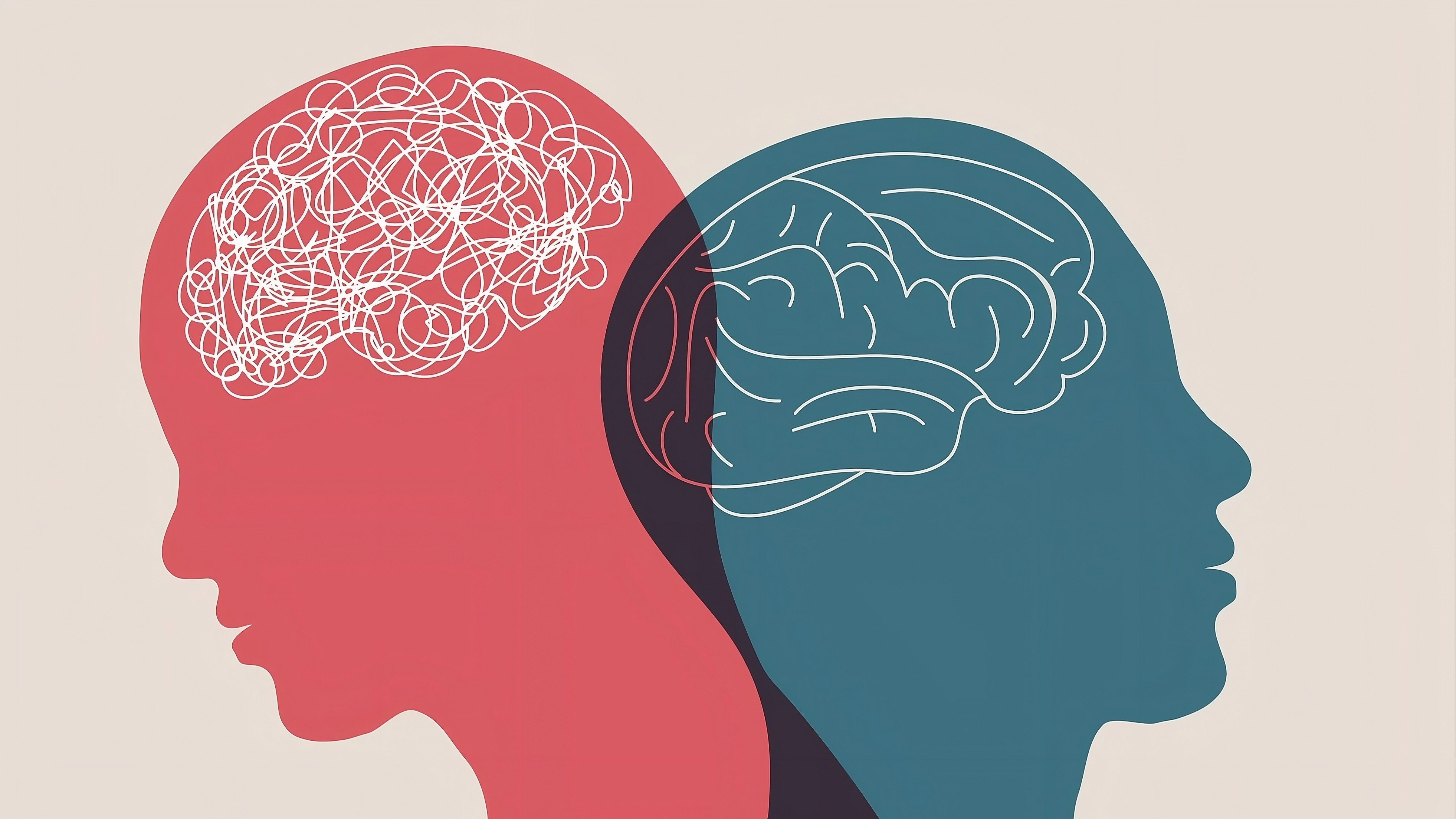
Recently, I been looking back at the biography of me, to see if my behavior still reflects what I am in the biography. And then there is something I noticed. Right there on the personality type, it says I am ENFJ-T. And then I realized that I took this test years ago. Since I’m changing day by day, I feel like it’s time for a re-run, once again. There’s a lot to explain here, but I’ll going in one by one.
First, I have to explain why we have this thing called a personality type. May I introduce you, the concept of MBTI. For those who don’t know, MBTI stands for the Myers-Briggs Type Indicator, a framework designed to categorize how humans perceive the world and make decisions. It isn’t meant to be a strict label that defines every single thing we do. Instead, think of it as a compass that points toward a person’s mental home base. It suggests that while we all use various traits—like being logical, emotional, or organized—we each have a natural preference for certain ‘modes’ of operating. Just like being left-handed or right-handed, we can use both, but one feels more natural and requires less conscious effort.
The system breaks personality down into four main dichotomies: how we get our energy (Introversion vs. Extraversion), how we take in information (Sensing vs. Intuition), how we make decisions (Thinking vs. Feeling), and how we organize our lives (Judging vs. Perceiving). By combining these, you get a four-letter code that acts as a shorthand for your cognitive style. For a long time, I carried that ENFJ-T badge, which suggested I was someone driven by external harmony and structured planning. But as I’ve dove deeper into this whole journey, I’ve started to wonder if those letters still capture the ‘why’ behind my choices, or if I’ve just become very good at pretending to be that person to get the job done.
So, with this in mind, I decided to write this episode, to find out about me, to see if I’m still the Protagonist, like Finn and Jake, Tanjiro, Pororo or so many other main characters in general. I came across a site called Mistype Investigator, and I am presented with a Cognitive Functions Test. Unlike the standard tests that just try to categorize you as ‘Introverted’ or ‘Social,’ this assessment digs into the actual mechanics of the brain. It operates on the theory that our personalities are built from eight specific ‘cognitive functions’—mental tools we use to either process information or make decisions. Some functions focus on the external world of people and physical data, while others are purely internal, dealing with personal values or abstract patterns.
What makes Mistype Investigator unique is its use of a sliding scale rather than a simple ‘Yes’ or ‘No’ button. Instead of forcing you to choose between two opposites, it allows you to rank how much you lean toward one mental process over another. It recognizes that as a music producer or a creator, you might use ‘Technical Logic’ to fix a frequency clash in a mix, but switch entirely to ‘Deep Intuition’ when you’re trying to capture a specific mood for a melody. By measuring these functions individually, the test aims to find your ‘true’ type by looking at your mental habits rather than just your surface-level behaviors. It’s less about which character you want to be, and more about how your internal engine actually runs when no one is watching.
Let’s begin. Now, rather than taking the test now, I need to discuss something first. Let’s… act for a bit. Say that a person came to me for the first time, and I’m Hypeventure. What would they find? They’d find someone who is fundamentally open-minded—the kind of person who always picks up when called and answers every question with total transparency. To me, being Hypeventure means speaking the truth, even when it’s complicated. I’ve realized that my personality is a strange, beautiful hybrid: I have the idealistic heart of Finn from Adventure Time, always ready to help and lead, but I also have the grounded, sometimes over-analytical perspective of Mordecai from Regular Show.
This duality is exactly why the Mistype Investigator test feels more relevant than the old ENFJ-T label I used to carry. It accounts for the fact that I can be a ‘romantic’ who is obsessed with the hyper-cute aesthetic of Vtubers, while simultaneously being a technical producer who demands absolute precision in metadata and backend processing. I’m not just one thing. I’m an observer who waits for the right moment to speak, a mentor who sits in the trenches with struggling collaborators, and a truth-seeker who refuses to compromise on authenticity. I’m a protagonist, sure, but I’m a protagonist who values the ‘core’ of the track as much as the ‘vibe’ of the room.
I’m pretty sure you seen my struggles, going from Episode 1 to 3, and also the episode 8 of this diary, but just to be sure, I worked with Google Gemini to develop a few ‘stress-test’ scenarios. These aren’t just random questions; they are designed to see how I actually behave when the ‘producer’ mask comes off and the human underneath has to make a choice.
First question: The ‘Ego-Driven’ Demo. Imagine I’m checking the label’s inbox late at night and I find an email that looks like this:
“Hey. I’ve seen your stuff. I think your ‘festival sound’ is getting a bit repetitive and safe. I have some tracks that actually push boundaries. You should sign me if you want your label to stay relevant in 2026. Let me know if you’re brave enough to listen.”
Let’s break this down. Saying the festival sound is ‘repetitive and safe’ is... well, it’s fine. I have no comment on that. Everyone is entitled to their musical opinion. But then we get to this: ‘You should sign me if you want your label to stay relevant in 2026.’ ‘Should’???
I’m sorry to whoever sent this email, but even I cannot accept a rude approach like this. It doesn’t matter how ‘boundary-pushing’ the music is. If the attitude is this toxic from the jump, that’s to me is a straight out goodbye. In fact, if I were a major player like Monstercat, that sender wouldn’t just be ignored, they’d be heading straight to a blacklist. You see, I prioritize mutual respect, so if an artist can’t master the basic ‘metadata’ of human decency, they aren’t ready to join the roster.
Next question: The ‘Perfect’ Nightmare. An artist sends a demo that is technically perfect. The mix is flawless, the sound design is top-notch, and it’s a guaranteed banger. However, the artist is a nightmare to work with. They are incredibly demanding, they refuse to follow my label’s branding guidelines (I’ll talk about this label in another episode, stay tuned), and most importantly, they refuse to credit the vocalist correctly. Someone will ask me this:
‘Hypeventure, do you sign the “Perfect Hit” because it makes the label successful (Logical/Business decision), or do you reject it because the artist’s “Vibe” and “Ethics” don’t match your values (Principle/Relationship decision)?’
Answers? Not quite. My standards for metadata are non-negotiable. It has to be correct, both for the artists involved and for the label, which acts as the bridge between the creator and the audience. To me, the key here is authenticity. If there isn’t a valid, ironclad reason why a vocalist isn’t being credited, I have no choice but to deny the entry. Even if the song is technically ‘perfect,’ adding more success to the label isn’t worth breaking the core of what we stand for. If the foundation of the collaboration is dishonest, the track loses its value in my eyes. I prioritize that bridge of trust between the artist and the audience over a quick business win every single time.
Question Number 3: The Finished Track Paradox. I’ve been working on a track for months. It’s sitting there, almost done, but it feels like it’s missing that final 1%. Suddenly, I find a new plugin, a new mixing technique, or a different musical style that makes my current version feel a bit ‘old’ or ‘safe.’ Now, do I scrap the whole thing and chase the new excitement? Or do I force myself to finish what I started?
My answer is specific: The track is already settled. At this stage, trying to shove in a completely new style or radical change has a high chance of breaking the ‘core’ of the song, making it sound worse than when I started. I have a very clear vision for the soul of the track, and I protect that. However, I’m not closed off to improvement. If a new plugin or technique can be used for the ‘backend’, meaning it helps the processing, hits industry standard specs, or makes the performance cleaner without altering the song’s identity, then I’ll try it. If it works well, I’ll add it to the rack. But I won’t let a ‘shiny new toy’ destroy the authentic heart of the music I’ve already built.
Moving on to social stuff, this one might be a little more relevant to a lot of people, I think. We’ve all been in that situation, you jump into a Discord voice channel or a group chat with a bunch of strangers, and it is absolute chaos. People are shouting, memes are flying, and the conversation is moving at 200 miles per hour. Someone might expect a ‘Protagonist’ type to jump in and try to dominate the room, but my approach is different. I’m an observer. I stay quiet, listening to the ‘vibe’ and the flow of the room, only speaking up when I have something meaningful or fitting to add. I’m not interested in adding to the noise. I’m interested in the signal.
However, silence does not mean I’m being closed off. I have a very simple rule: I am open-minded, and when I get called, I always answer, if I could. If someone reaches out for help or asks me a question about my process or who I am, I will explain it as truthfully as I can. I’m Hypeventure, of course I speak the truth. I don’t even hide behind a persona. Whether it’s talking about my obsession with the hyper-cute aesthetic of Vtubers or the technical struggles of running a label, I stay transparent. I might be the guy listening from the corner of the call, but if you need me, I’m there, 100% authentic, every single time.
Next, the Entertainment Paradox. I know, I know, everyone sees me and thinks: ‘Hypeventure loves Vtubers because they are... cute? I think?’ And while that’s part of it, it’s not the only thing I count. There is a deeper question here: When I watch a Vtuber, what is the primary thing that actually draws me in? Is it the Aesthetic and Performance, or is it the Personal Connection?
The truth is, it’s a balance of both, but I’ll admit I lean a tiny bit more toward the Aesthetic and Performance. As a producer, I have a deep appreciation for the craft, like the high-pitched, ‘kawaii’ vocal styles, the character design, and the way the performance creates a specific ‘vibe.’ But because I’m a bit of a romantic at heart, I’m also looking at the soul behind the avatar. I’m thinking about their hard work and the ‘idealized’ version of who they are. To me, it’s not just ‘cute’ for the sake of being cute; it’s about a performance that feels authentic to the character. It’s that same search for a ‘core’ that I have in my music—I’m drawn to the beauty of a well-executed vision that still feels like it has a human heart beating inside it.
One more question before diving to the test. I’ve mentioned Finn from Adventure Time before, but I’ve also been holding onto another big influence: Regular Show. It’s been my favorite cartoon for a long time (and I’ll be dedicating an entire episode to it soon, so stay tuned for that).
In these shows, we see two very different ways of handling life. Finn is the hero who rushes into things because it’s ‘the right thing to do’—that pure, idealistic heroism. Mordecai, on the other hand, is the guy who over-thinks everything, getting ‘stuck’ because he’s worried about how he’s perceived or how someone else feels. He’s the king of relatability and over-analysis.
So, here’s the question: If a collaborator sends me a message saying they’re feeling depressed and want to quit music, who do I become? Do I be Finn or do I be Mordecai?
My answer is a hybrid of both. I don’t just give a ‘Main Character’ pep talk and tell them the world needs their music like Finn might. Instead, I choose to sit in the trenches with them. Like Mordecai, I listen. I let them vent, and I might share a time when I felt the exact same way, focusing on the shared ‘pain’ rather than just trying to ‘fix’ it immediately. But once we’ve sat in that space together, that Finn energy kicks back in. I use that shared vulnerability to guide them back toward their own strength. I’m not just a hero or just a bystander. I’m a peer who isn’t afraid to show his own scars if it helps someone else find the courage to keep creating.
Speaking of overthinking, I used to have a real habit of it. There were times when I’d find myself caught in a loop, imagining a bad future or obsessing over every potential mistake I might make. The last time this really hit me was while I was writing ‘Bridges’ with a collaborator (and yes, you guessed it—there’s an episode coming for that song soon, too).
When you’re a producer and a label owner, the pressure to be ‘perfect’ is always there. For me, the ‘wrong move’ isn’t usually about the music itself, because this can be fixed easily. What’s worse is about how I talk, the way I speak, and how I communicate. I’ll be honest: I struggle with communication issues.
I worry that a single misspoken sentence or a poorly phrased email will bring the whole bridge down. I’ve learned that my overthinking is often just my brain trying to protect the ‘Truth-Speaker’ inside me. I care so much about the authenticity of the result—and the integrity of the connection, that I start to panic about every possible failure in how I’m perceived. It’s like I’m trying to mix my own words with the same precision I use for a track, terrified that one ‘bad frequency’ in my tone will ruin the relationship.
Kay, enough of who am I. Now it’s time to get to the test. And wow… that’s a lot of questions. But I’ll try to summarize. Since we’ve got the framework, the answers I’ve already shared, plus traits like being an ambivert, being sensitive, and being a bit of a ‘fragile weak boy’ who is easy to cry and easy to ‘woaa’ at a cute little girl’s moe voice, this should be enough to define my personality.
But like I said, we’re doing a real personality test here. Most questions are too easy to answer. If I’m not getting stretched out like Donald Duck in a rage, or feeling like Puss in Boots getting crashed out to near death on “Hot Ones”, then there’s no way I can find out the truth about myself. I need to be pushed. I need the heat. So… uh… yeah. Let’s see if I survive the sliders.
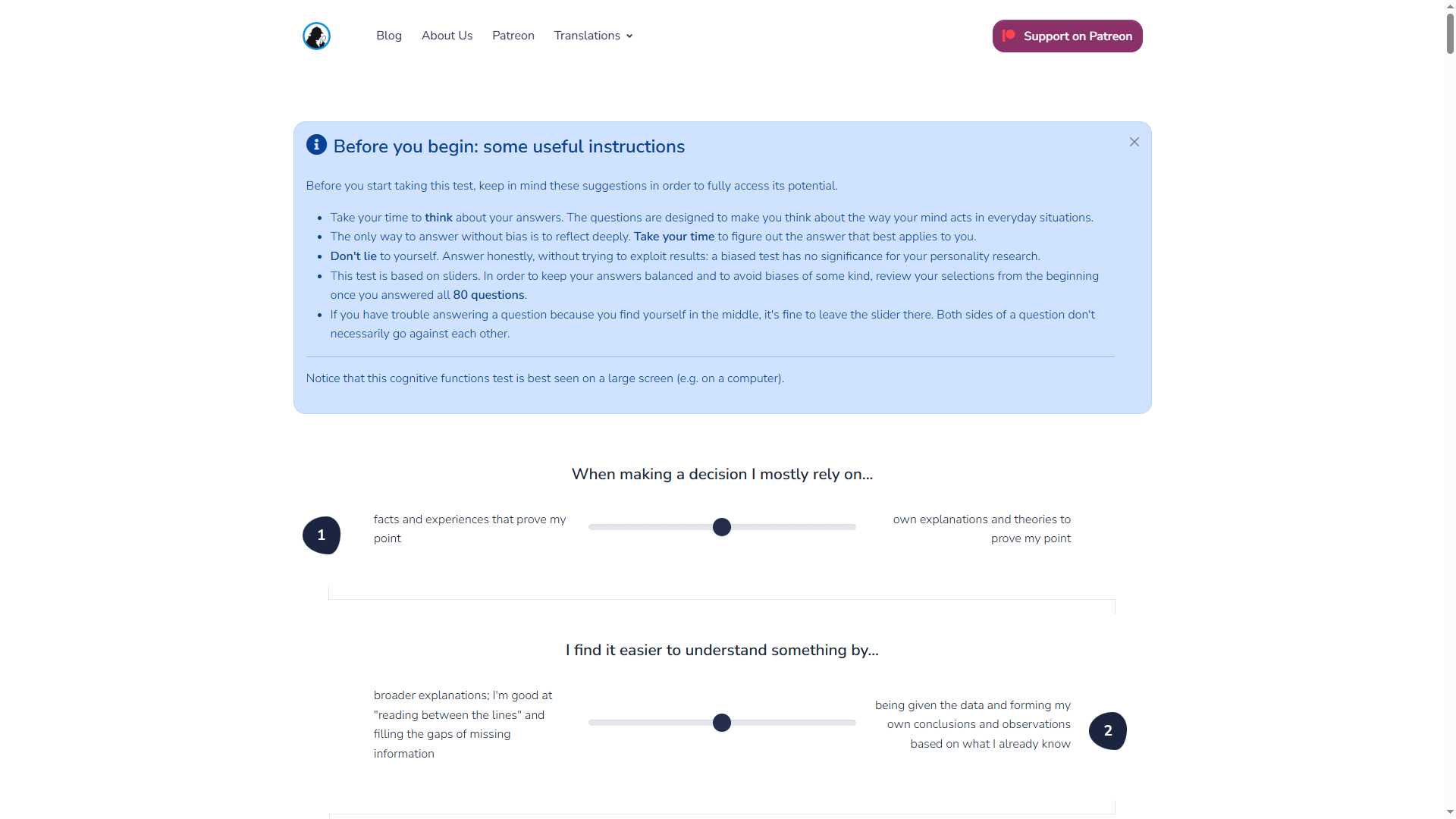
Good thing we have a note here. So here’s the recap. No lying to myself, take times, be honest, be truthful. I’m taking those notes to heart. There’s no rush here. I’m not just trying to fly through 80 questions to see a four-letter code at the end. I’m reflecting deeply on how my mind actually acts in everyday situations, not just how I wish it acted. If I find myself in the middle of a question, I’ll leave the slider there. Balance over bias.
Because if I’m going to call myself a Truth-Speaker, I have to start with the truth about me - even if that truth is as messy as a crashed-out Puss in Boots. No lies, no shortcuts. Just the raw metadata of Hypeventure.
80 questions seems like a lot, but patience is the key. Let’s go by sets. 80 questions, split into 8 sets of 10. That’s it. Let’s dive into the first set: Questions 1 to 10. This opening block really puts the pressure on how I process information and make decisions. It’s all about the ‘Internal vs. External’ struggle. The questions dig into whether I rely more on established facts and proven experiences or if I trust my own personal theories and unique explanations to make sense of the world. There’s a heavy focus on how I understand things—whether I’m ‘reading between the lines’ to fill in the gaps of a story or if I prefer to take the raw data and form my own conclusions based on what I already know. It’s essentially testing the foundation of my ‘Truth-Speaker’ persona: do I seek the truth in the world around me, or do I find it within my own logical framework? It’s a lot of self-reflection right out of the gate, forcing me to decide if I’m a ‘big picture’ visionary or a ‘data-driven’ analyst.
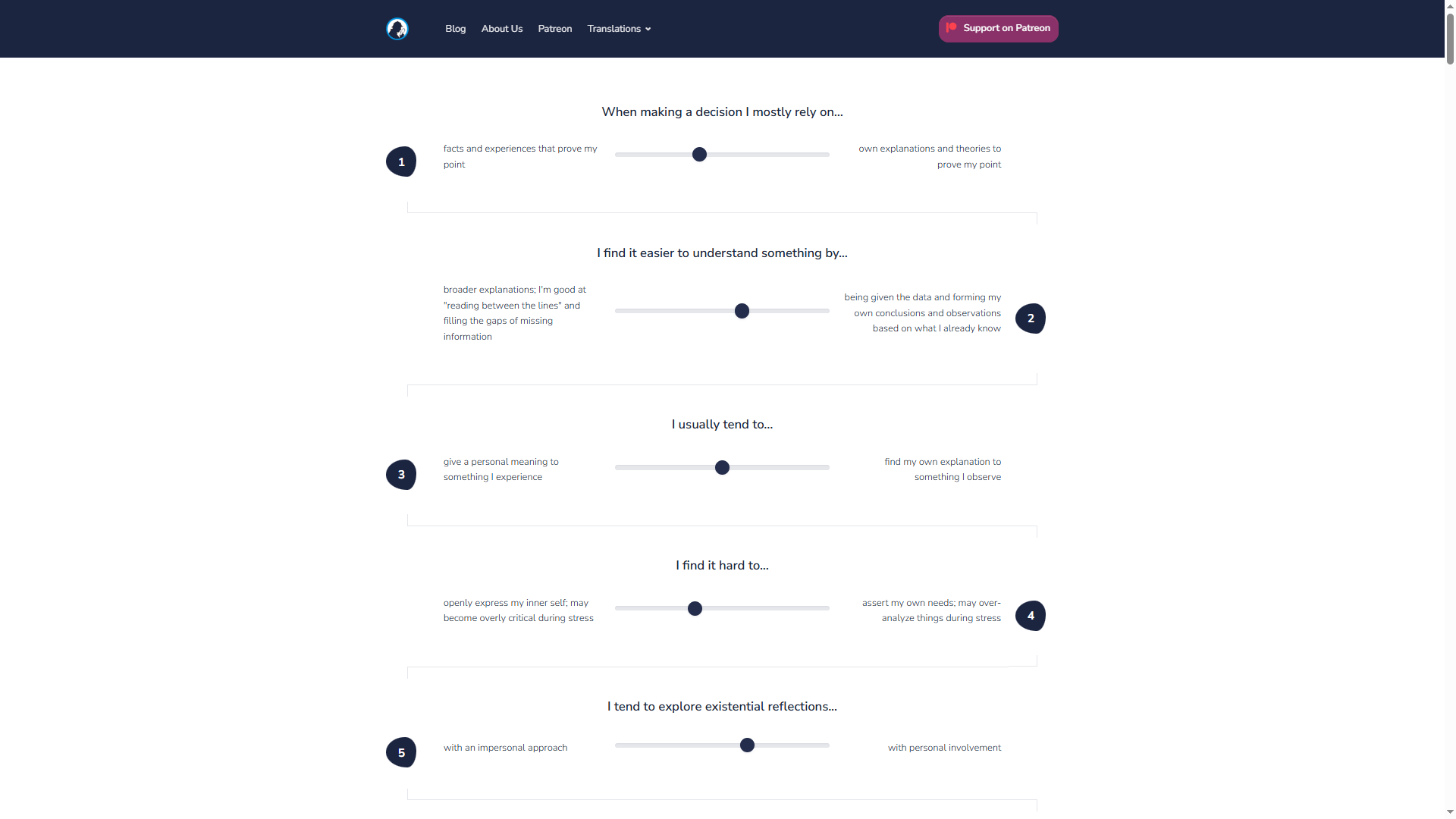
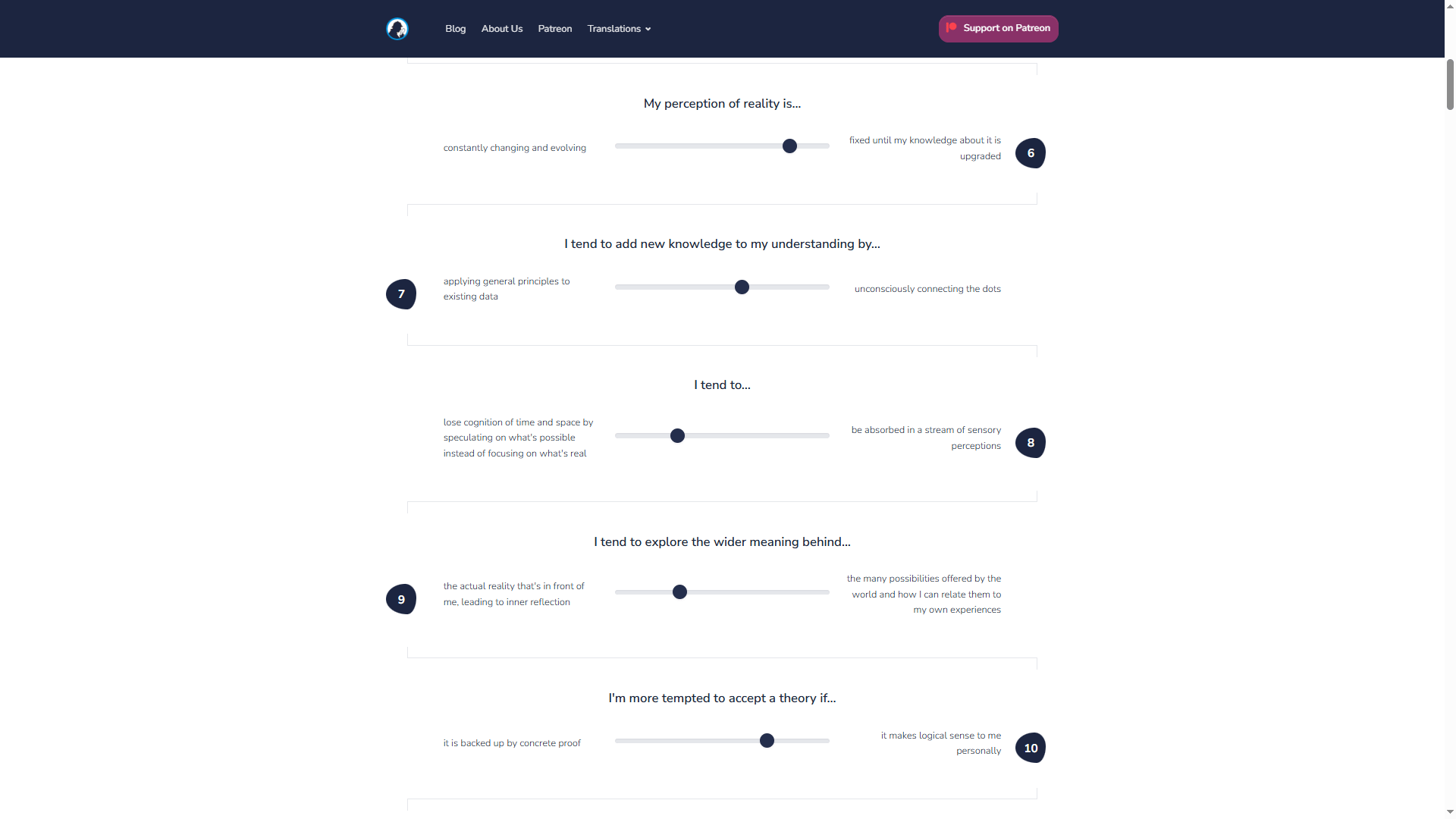
For this first set, my choices were a reflection of my need for stability and my history as an observer. I gravitating toward a “Balanced Bridge” strategy, placing most of my sliders in the Middle-Left. For example, while I wouldn’t say I’m obsessed with being a total perfectionist in every part of my life, I definitely lean into that stereotype when it comes to music production and technical data. I tend to rely on Facts and Experiences because the metadata has to be right. So this technical groundedness serves as a shield for my more sensitive side.
The most honest pulls for me were related to survival and reflection. On Question 7, I pulled strongly toward reality being fixed until my knowledge is upgraded. I don’t change my mind on a whim. I wait for the “data patch.” This caution comes from a place of protecting my peace. Having been bullied in the past, I value the quiet era I’ve built for myself now. I tend to take the actual reality in front of me and turn it into inner reflection, processing the world carefully because I know how fragile that peace can be.
This sensitivity is most visible in my response to pressure. On Question 6, I pulled the slider hard toward being over-analytical and critical under stress. I’ve realized that I cannot handle a “1 vs 100” battle or public drama. It causes my mind to spiral into a dark, self-destructive place far beyond simple depression. Because I fear those “battles,” my brain defaults to hyper-analysis—over-thinking every detail to avoid mistakes before they happen. This set confirms that I use logic as a structure to protect my inner self from the chaos of the outside world.
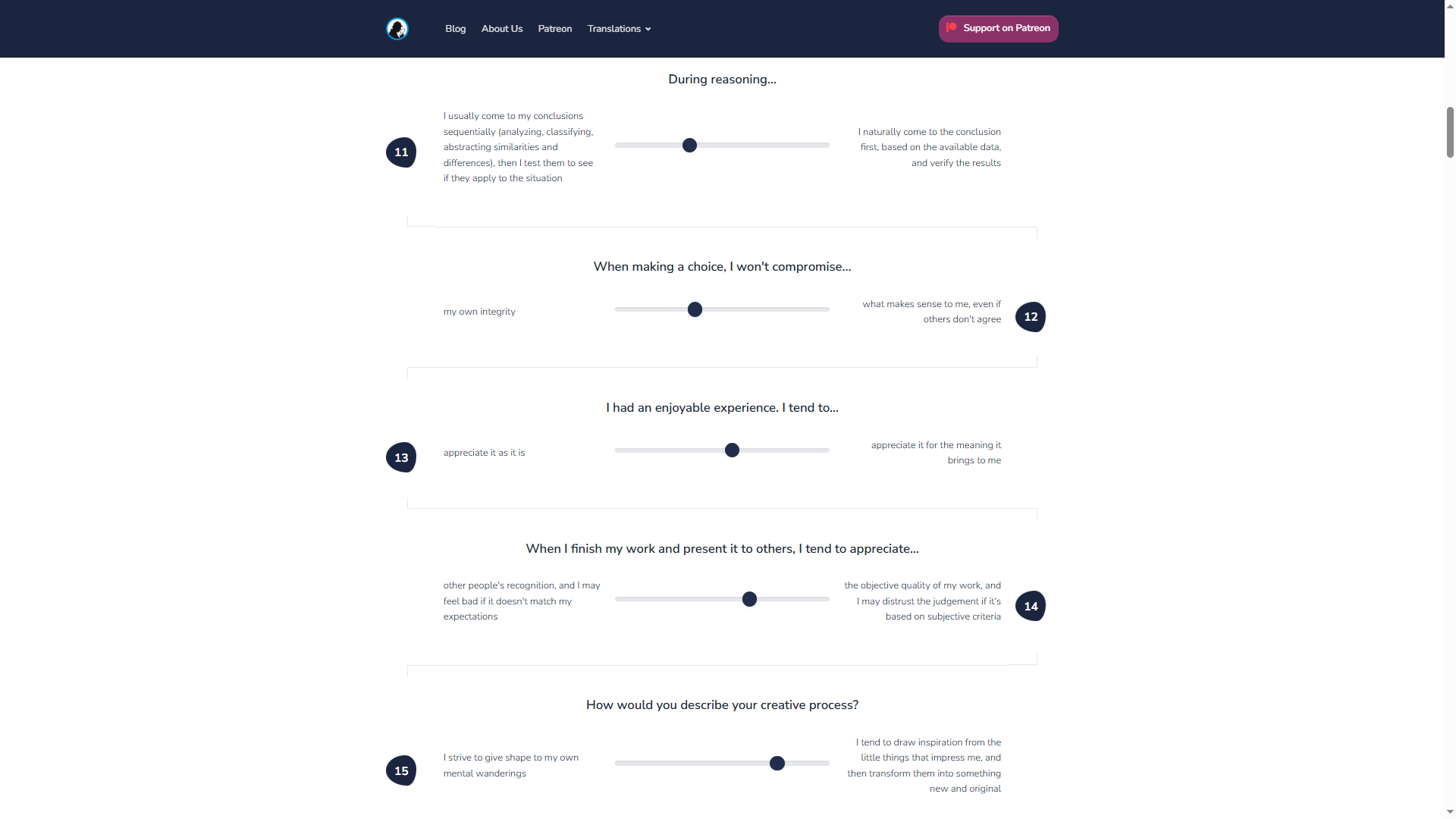
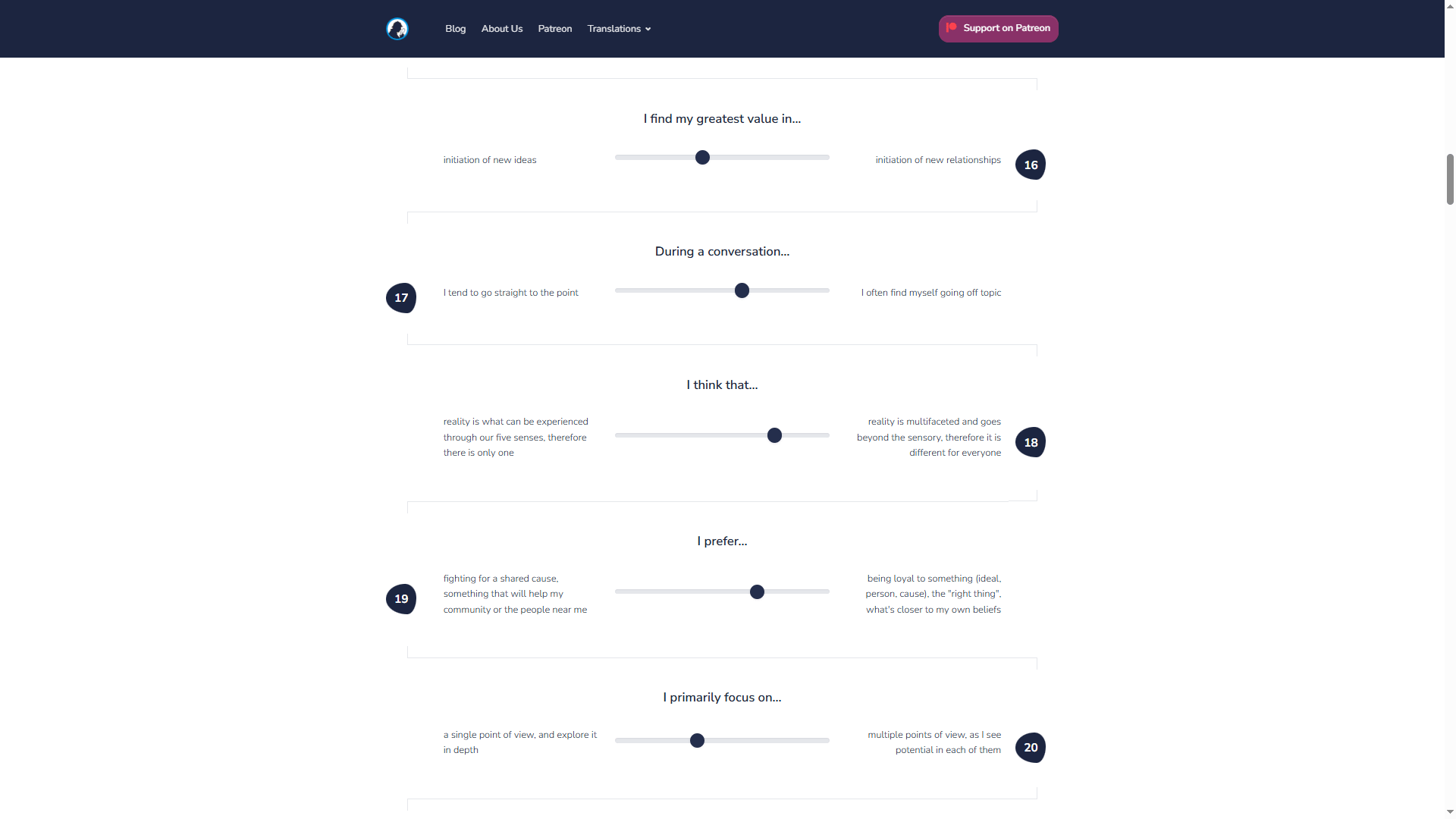
Moving into the second set of questions, the focus shifts away from how I receive data and starts digging into the “Internal Architect” of my soul. If the first set was about the world coming at me, this set is about how I process, filter, and protect my identity from the inside out. This block essentially puts my “Truth-Speaker” persona to the test by exploring the tension between my own logical framework and the outside world’s recognition. It forces me to decide if I trust a conclusion because it “clicks” with my personal understanding or because it’s technically proven, and whether I value objective quality in my work—like a perfect mix—over the validation of others.
This set also hits deep on my “Sensitive Boy” side by questioning the nature of reality and loyalty. It asks whether I see reality as a single objective fact or as something multifaceted and unique to every person’s inner experience. For someone like me, who values peace and fears the chaos of drama, these questions about shared causes versus personal integrity are revealing. It’s about determining if I am an independent thinker following my own compass or if my world is primarily built on the relationships and creative wanderings I share with others.
And here are my answers. It’s complicated. While the first set was about how I take in the world, this second set revealed the “Internal Architect” that governs my life. I found myself making a major stand on Question 12, where I refused to compromise my personal integrity for the sake of logic or others’ opinions. This is the heart of my “Truth-Speaker” identity—I would rather stand alone in my truth than be a “fake” version of myself to avoid drama. This theme continued into how I perceive reality; I pulled strongly toward the idea that reality is multifaceted (Question 18). I don’t believe in a single, cold, objective truth that everyone sees the same way. To me, reality is shaped by our inner experiences, our past, and the meaning we project onto the world.
My social and creative choices also showed a clear preference for depth over breadth. In conversations, I admitted that I often go off-topic (Question 16), which reflects how my mind unconsciously connects dots across different experiences rather than following a straight, narrow line. When it comes to my focus, I pulled toward exploring a single point of view in depth (Question 20) rather than chasing every possibility. I’m a “Deep Diver,” not a “Surfer.” Whether it’s a specific sound design or a personal belief, I want to go to the bottom of it. Even when I lean toward a “shared cause” or community (Question 19), I do so through the lens of my personal loyalty to what is right. Ultimately, this set confirmed that I am not just a data-driven producer; I am an observer who uses technical precision to build a fortress around a very sensitive, principled inner core.
Moving into the third set, we enter “The Mirror of Experience.” This block acts as a reflection of how I actually live within it and handle the echoes of my past. Pretty much a heavy section for me because it forces a confrontation between the “Fragile Boy” who survived bullying and the “Hypeventure” who now pioneers his own path. It digs into whether I view my memories as raw, objective facts or if I wrap them in personal meaning to make sense of the journey.
The set also challenges my social survival strategies and creative drive. It explores whether I seek a peaceful, shared atmosphere for safety or if I’m just there to chill, and how independent I truly am from the judgment of others—a question that hits right at my fear of “1 vs 100” drama. From deciding if I am driven by an inner vision to how I handle moral implications when helping others, this set acts as the ultimate bridge. It asks if I am still running from the past or if I am finally using those reflections to build a solid, authentic identity.
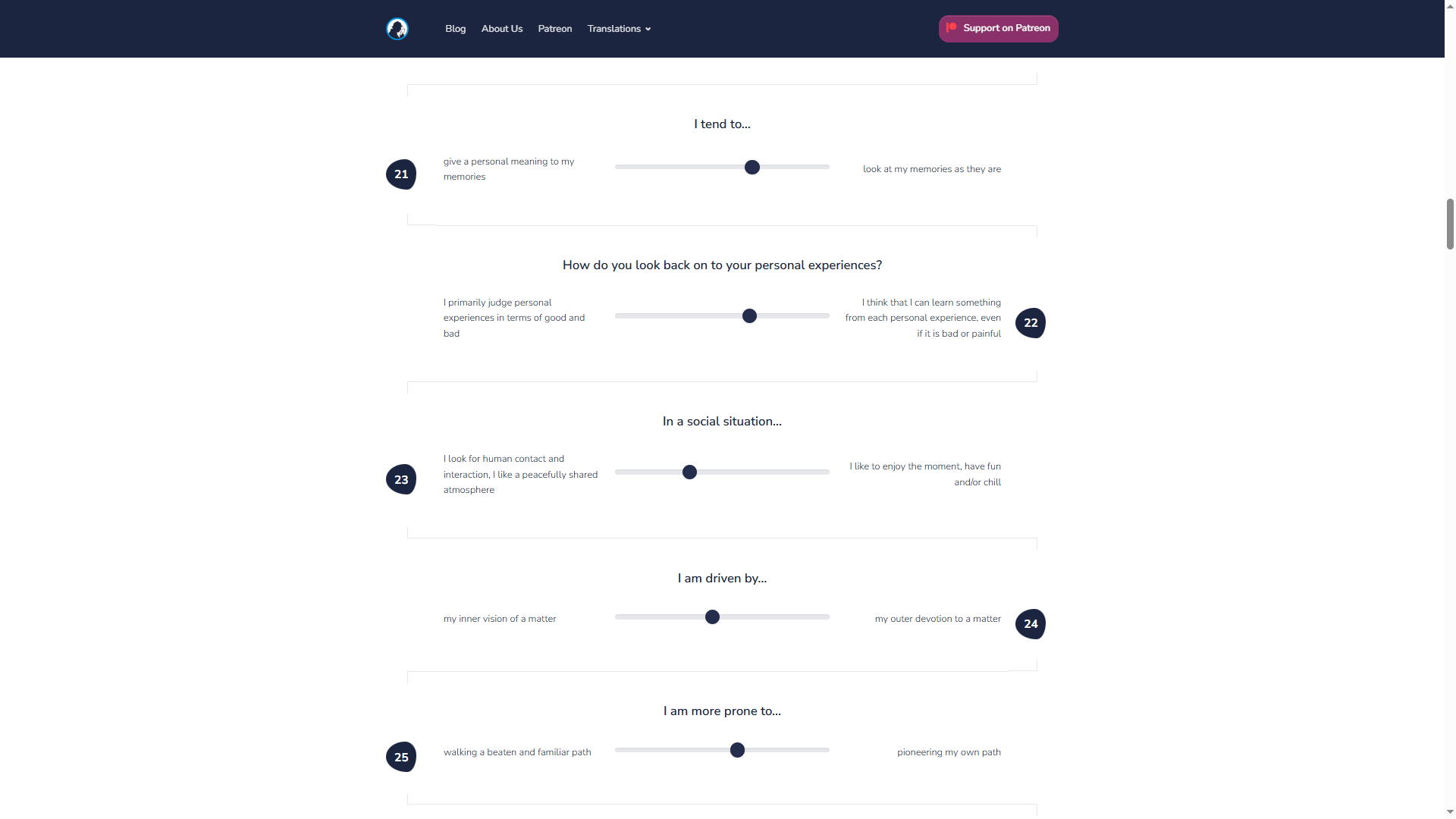
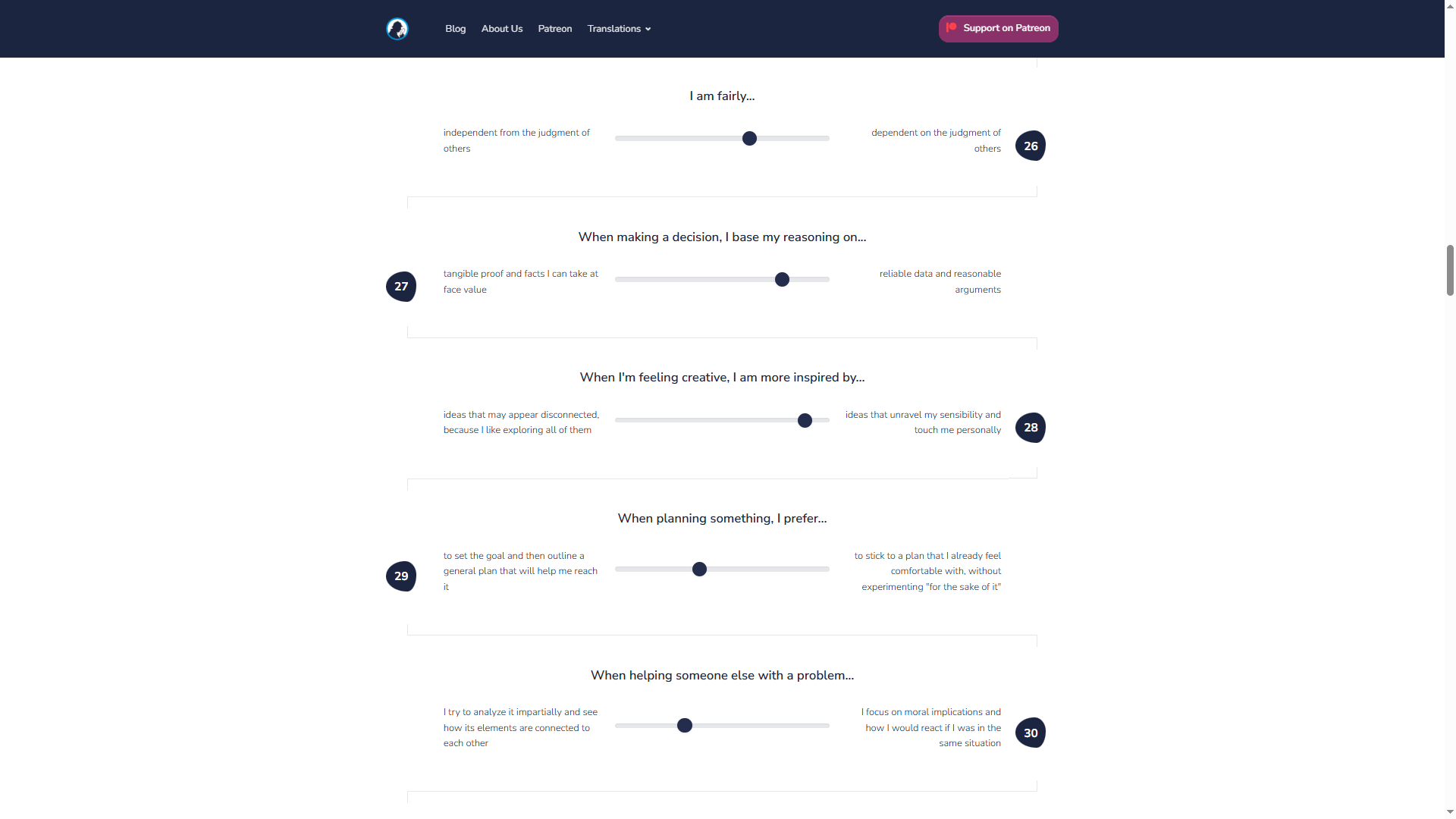
And my answers for this set are fair. “The Mirror of Experience” showed me that I’m in a transitional phase—balancing the safety I need with the pioneer I am becoming. And I made a significant pull toward ideas that unravel my sensibility (Question 28), because for me, creativity isn’t just a random playground, it’s a way to process things that touch me personally and deeply. This connects to how I view my personal experiences, leaning toward the belief that I can learn something from every moment, even the painful ones (Question 22). Instead of just seeing “good” or “bad,” I’m looking for the lesson.
I also realized how much I value a peacefully shared atmosphere in social situations (Question 23). It’s not just about “having fun” for the sake of it; it’s about feeling a secure human connection. While I admitted that I still feel somewhat dependent on the judgment of others (Question 26)—likely a lingering echo of past drama—I am simultaneously driven by my inner vision (Question 24) and a desire to pioneer my own path (Question 25). I’m not just walking a beaten track anymore. I’m building a label, selecting collaborators based on a logic that feels right to me, and using my “Manual” brain to organize a life that finally feels like my own. A delicate balance of staying grounded in reliable data while letting my internal compass lead the way, isn’t it?
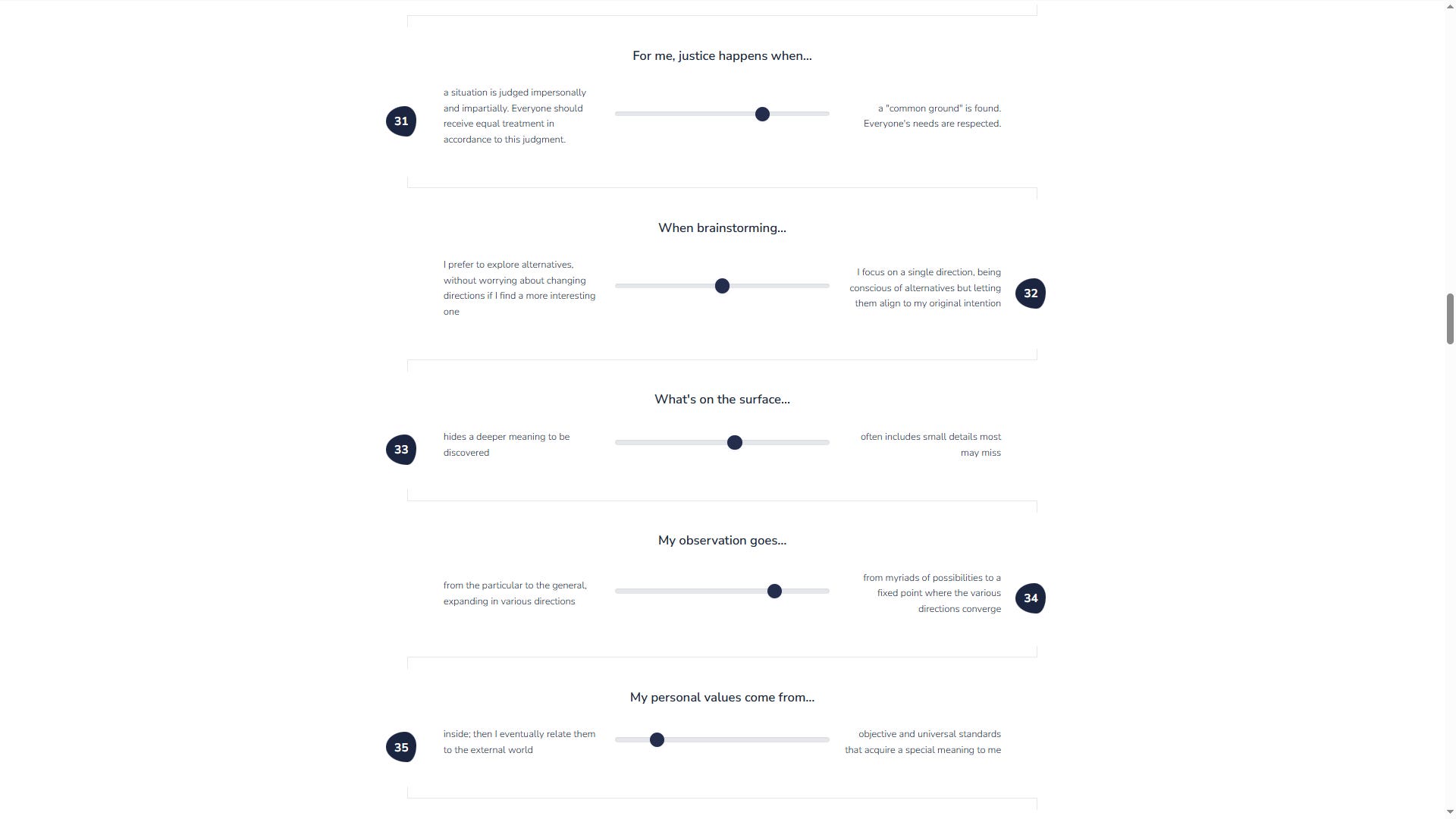
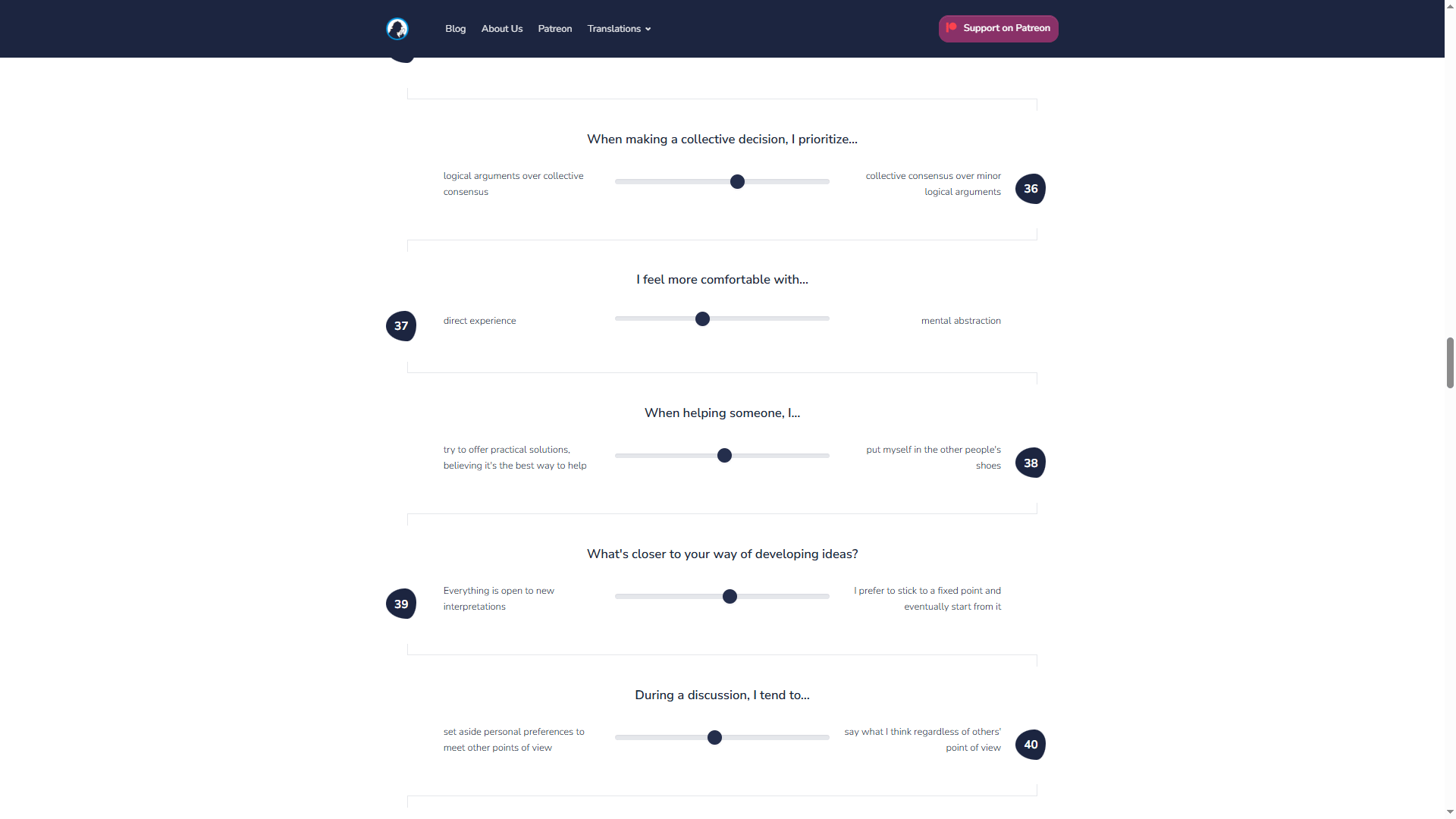
Set 4: The Navigator of the Deep. This block of questions shifts the focus toward my mental processing and my ethical compass. It’s where the “Music Producer” meets the “Truth-Speaker.” This set digs into how I handle the abstract versus the practical—whether I’m more comfortable with direct experience or mental abstraction (Question 37). It challenges me to define my sense of justice: do I prefer an impartial, equal treatment, or a search for common ground where everyone’s needs are respected (Question 31)?
This set also gets into the “nitty-gritty” of my creative and social filters. It asks how I observe the world—whether I see a surface that hides a deeper meaning or one that is simply made of small, missing details (Question 33). More importantly, it hits on the friction of my role as a leader: when making a collective decision, do I prioritize logical arguments or collective consensus (Question 36)? And during a discussion, do I set aside my preferences to meet others, or do I say what I think regardless of others’ points of view (Question 40)? This is the set that determines how I navigate the world as “Hypeventure”, balancing my need for harmony with my unyielding commitment to the truth.
So, here's my answers. I found that my mental processing is heavily anchored by a need for a fixed point (Question 39). Whether I’m designing a brand identity or layering a drop, I need that central theme to act as my north star. I also noticed that while I value direct experience and practical, technical reality (Question 37), I use my inner values as the primary filter for how I relate to the external world (Question 35). My “Truth-Speaker” side is balanced by a deep desire for common ground (Question 31) and a tendency to put myself in others’ shoes when they need help (Question 38).
I’ve realized that in social and professional settings, I lean toward consensus (Question 36). I would rather have a team that feels like a family than a “perfect” result born from conflict. Even in heated discussions, I tend to set aside my personal preferences just a bit to meet other points of view (Question 40), prioritizing harmony over being “right.” However, my observation still leans toward the small details that others miss (Question 33) and bringing a myriad of possibilities down to a convergent, fixed point (Question 34). I am a builder who values the people in the room just as much as the blueprint on the table.
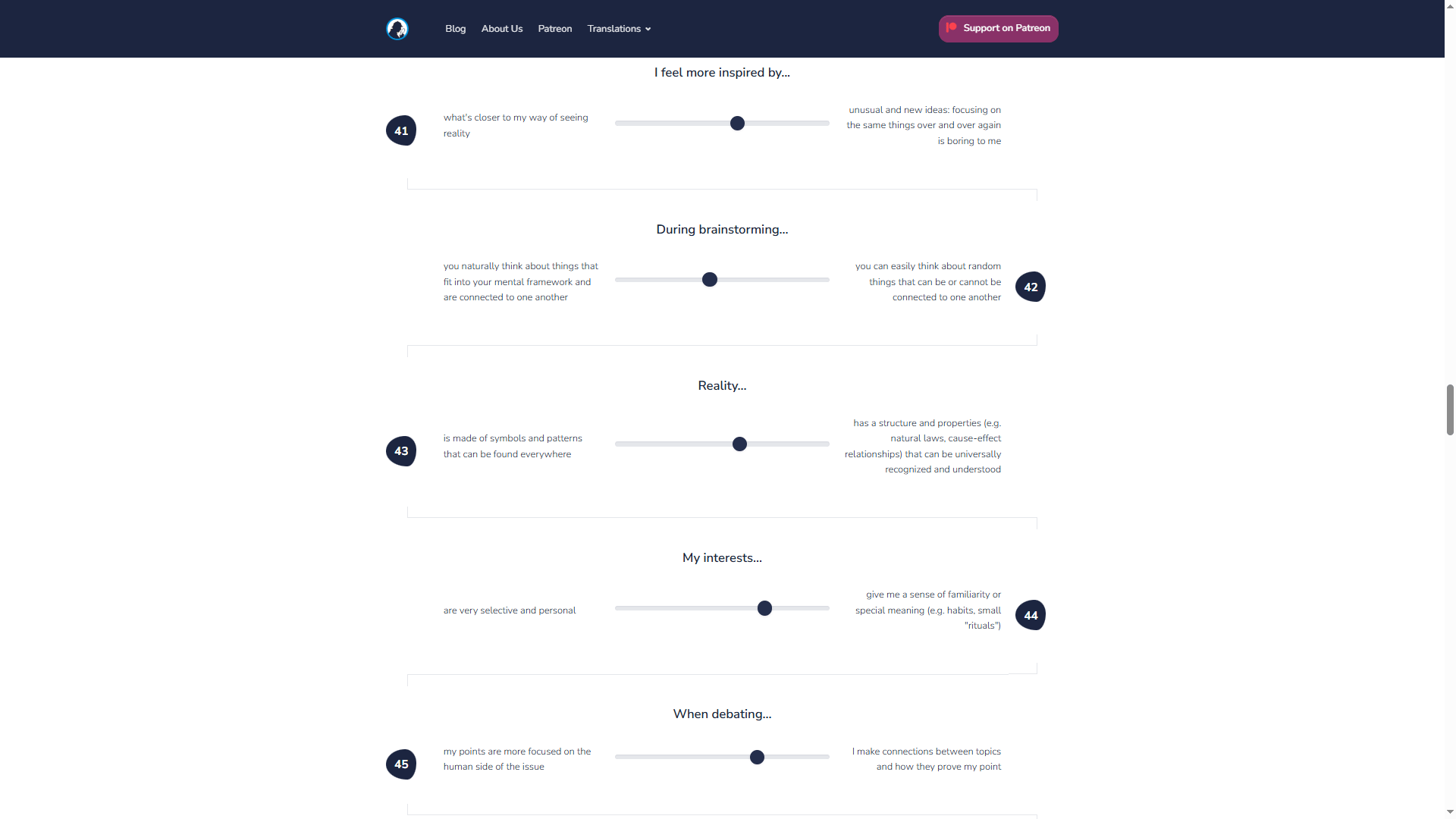
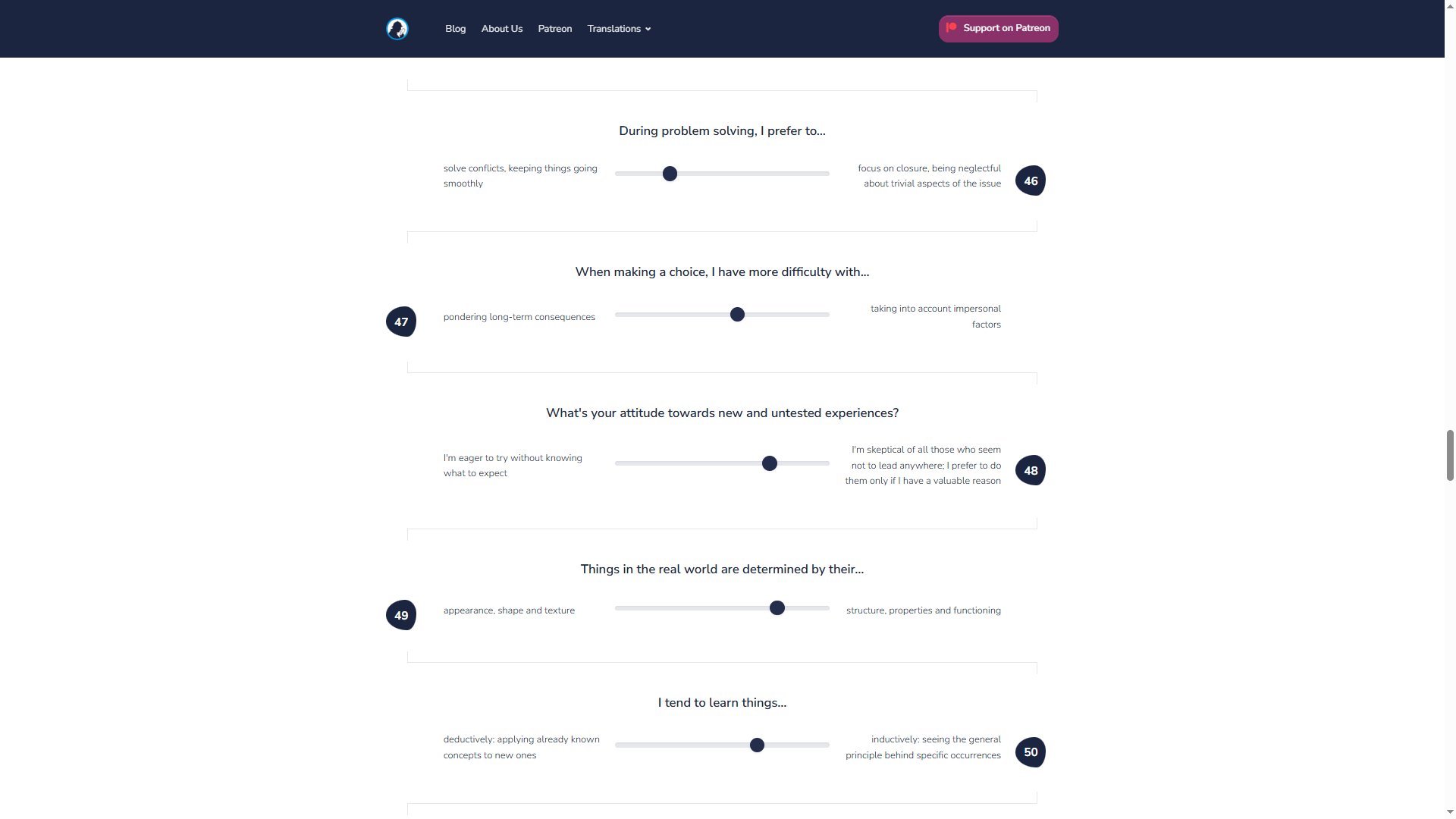
Set 5: The Pattern Architect. This is where the test moves from “how I act” to “how I perceive.” It challenges me to define my relationship with reality and the unknown. This set explores whether I see the world as a collection of symbols and patterns (Question 43) or a structure of natural laws and cause-effect relationships. It digs into my curiosity: am I someone who thrives on unusual and new ideas (Question 41), or do I prefer sticking to a framework that fits my existing way of seeing reality?
It also touches on the tension of problem-solving—whether I prioritize keeping things going smoothly (Question 46) or focus strictly on closure, even if it means neglecting the smaller, trivial aspects of an issue. Finally, it asks how I face the void: is my attitude toward untested experiences one of eagerness (Question 48), or am I skeptical of paths that don’t seem to lead anywhere? This set is the final blueprint of my intellectual DNA, showing how I bridge the gap between the “random bits” of life and the fixed points of my vision.
I’ve confirmed that my mind is built on a foundation of structure and functioning (Question 49). I don’t just look at the surface; I need to know how the gears turn. I found that I am most inspired by things that resonate with my internal reality (Question 41), yet I keep a window open for random brainstorming (Question 42) to keep the ideas fresh. My interests aren’t just hobbies; they are meaningful rituals that give me a sense of familiarity (Question 44).
When it comes to the “heavy lifting,” I’ve realized that I prefer to solve problems by keeping things smooth and maintaining a peaceful atmosphere (Question 46), even though I struggle more with impersonal factors than with long-term planning (Question 47). I’ve also noted that I’m a strategic explorer—I’m skeptical of untested experiences unless they have a valuable reason to exist (Question 48). Finally, my learning style is inductive (Question 50); I like to see the general principles emerge from specific moments, proving that while I love the “Manual,” my heart is always searching for the “Theme.”
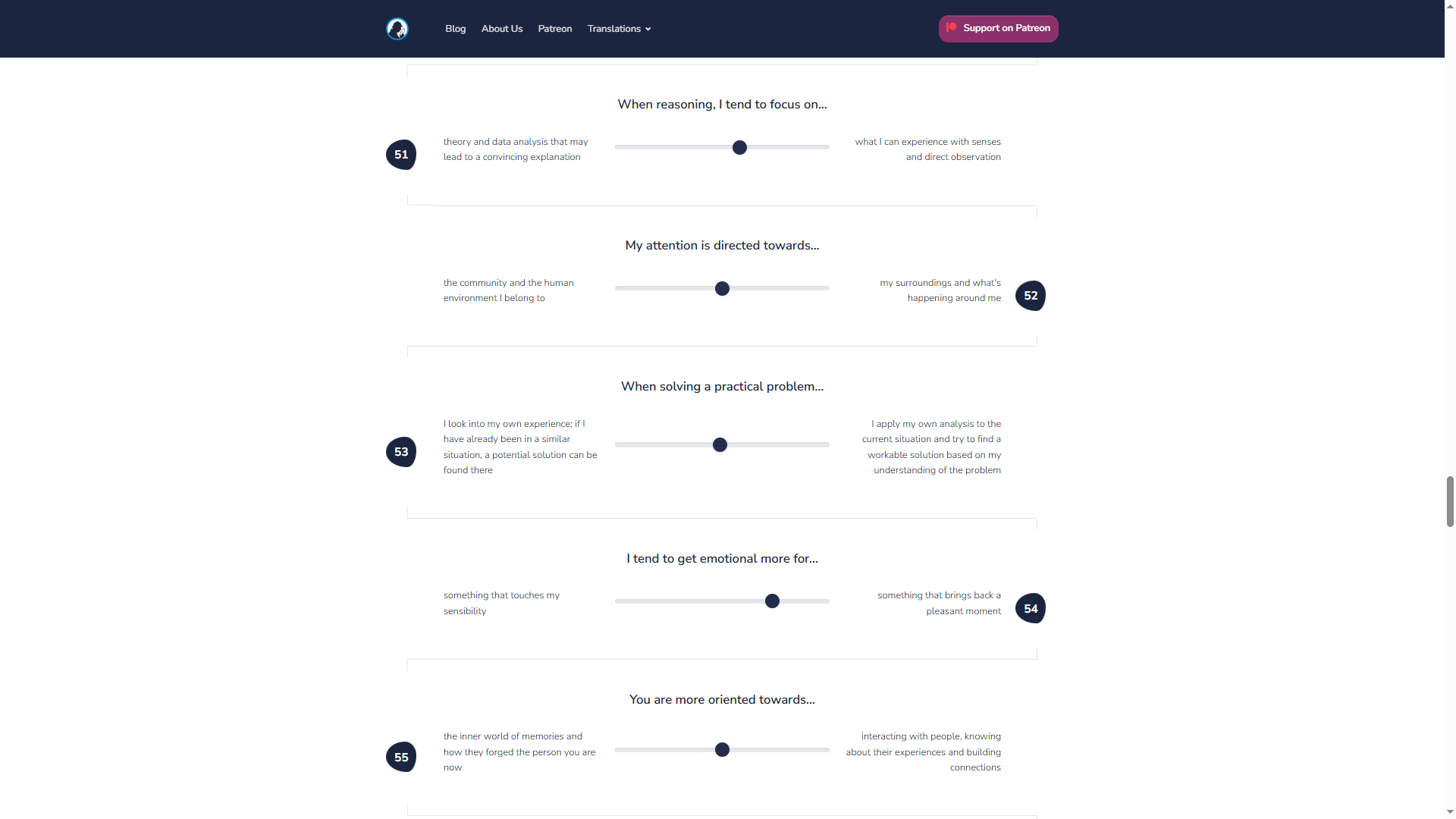
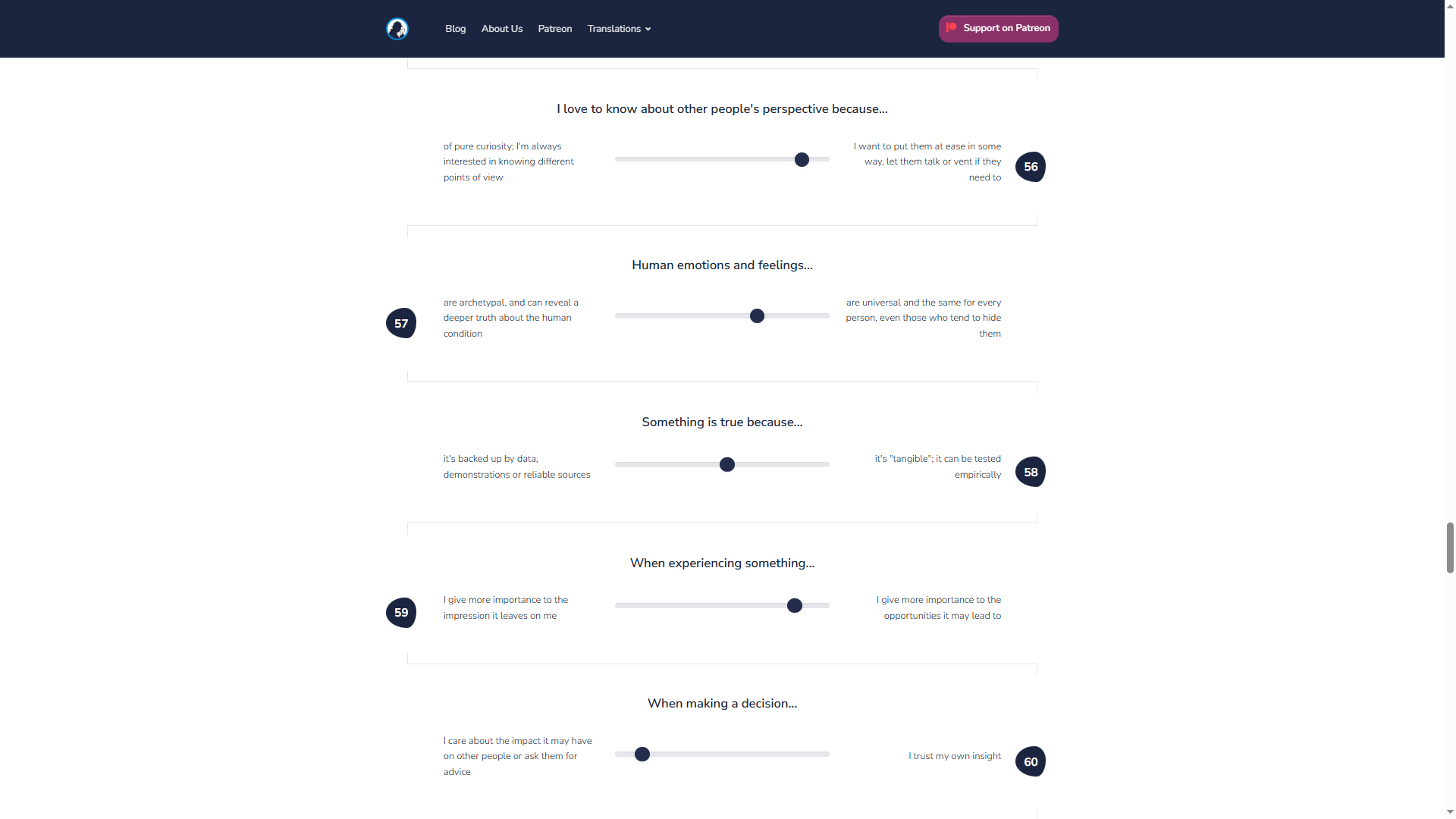
Set 6. This section dives into the mechanics of my daily awareness and how I interact with the world around me. It asks whether I focus my reasoning on convincing explanations (Question 51) or on what I can experience with my senses. It probes where my attention naturally goes: toward the human community I belong to (Question 52) or toward my immediate physical surroundings.
This set also explores how I solve practical problems—whether I look back at my past experiences (Question 53) or apply a fresh analysis to the current situation. It gets personal, asking if I am moved more by things that touch my sensibility (Question 54) or by nostalgia for pleasant moments. Ultimately, it seeks to find if I am more oriented toward my inner world of memories (Question 55) or the act of building connections with others. This is the set that defines the “Direct Experience” side of my personality.
I think it’s clear that I live right on the boundary between the physical and the personal. When I reason, I lean toward direct observation and my senses (Question 51), trusting what I can actually see and hear over pure theory. My attention is a delicate balance, sitting right in the middle between the community I belong to and the immediate surroundings that ground me (Question 52).
Practical problem-solving for me is an even split, too—I value past experience as much as I value fresh analysis (Question 53). However, my heart shows its true colors when things get personal. I’m deeply moved by things that bring back pleasant moments (Question 54), and I find myself perfectly balanced between my inner world of memories and the drive to build connections with others (Question 55).
When I interact with people, I do it with purpose: I’m there to put them at ease and let them vent (Question 56), believing that emotions are universal (Question 57). While I need things to be tangible to be true (Question 58), I’m always looking ahead—giving more weight to the opportunities an experience might lead to (Question 59) and always prioritizing the impact my decisions have on others (Question 60).
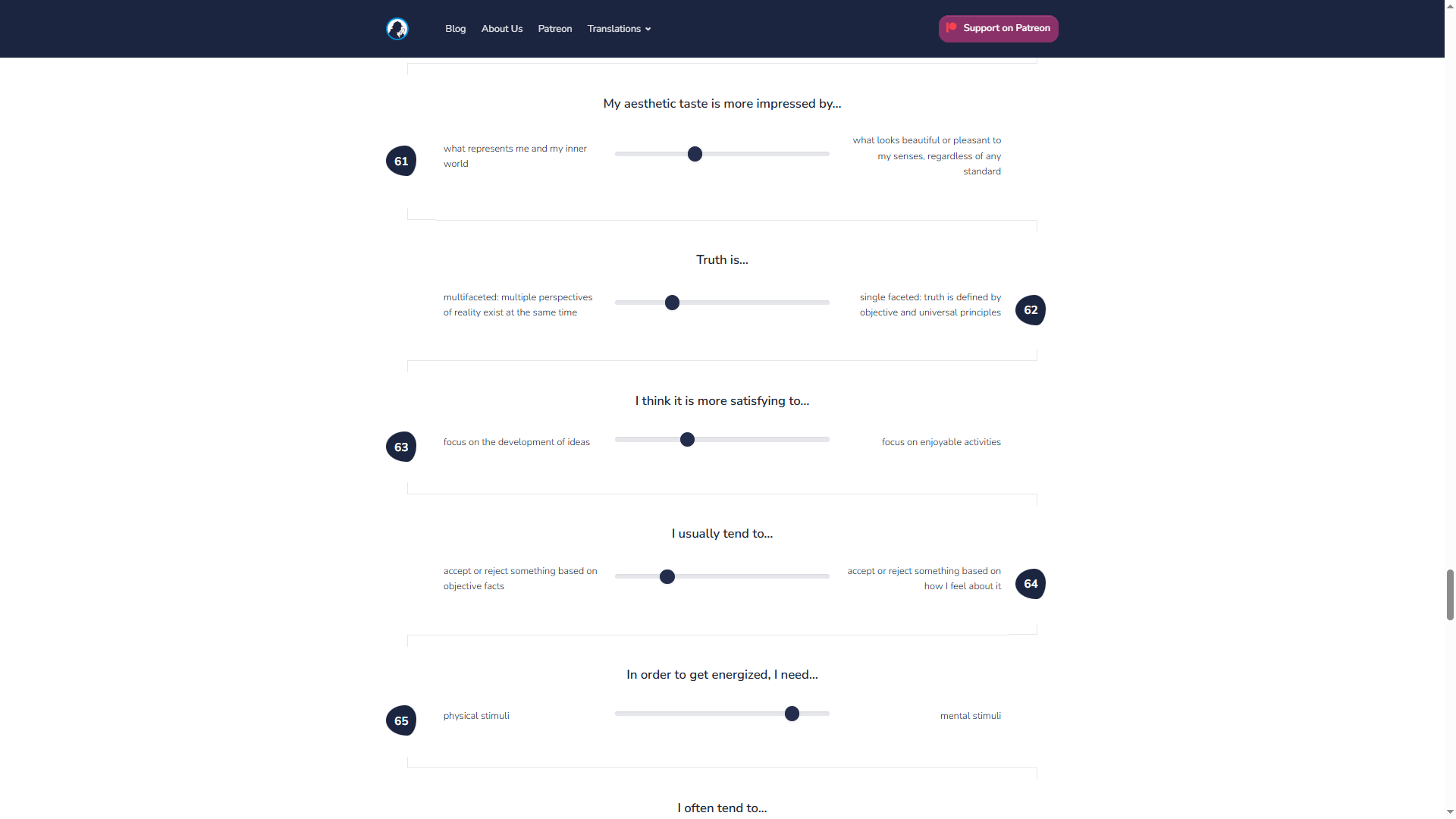
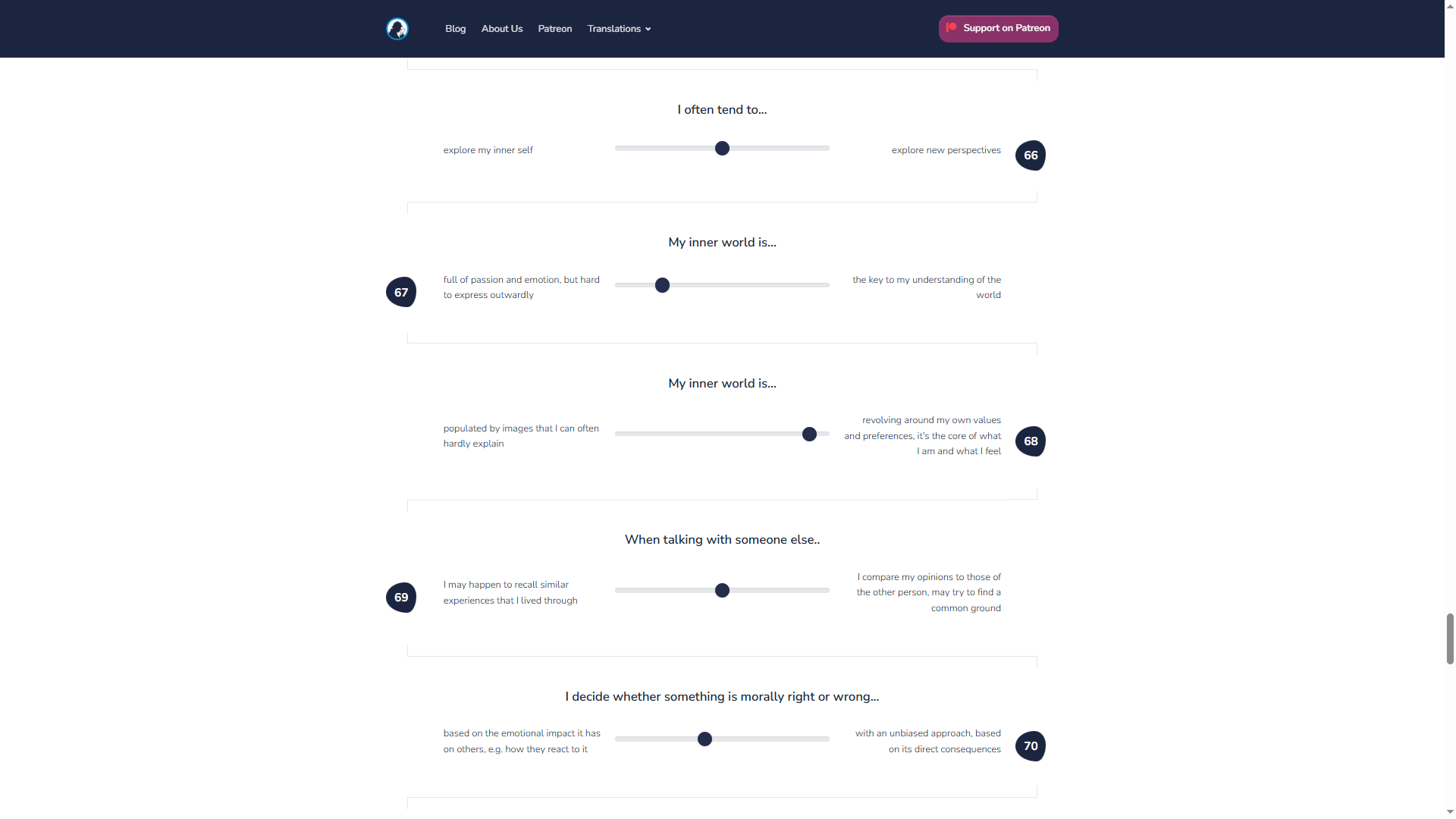
Final 20, we are now on set 7! Here, I will exploring my aesthetic taste, whether I’m drawn to what represents my inner world (Question 61) or simply what is pleasing to the senses. It asks a massive philosophical question: is Truth multifaceted and perspective-based (Question 62), or is it a single-faceted objective reality? I’ll look at what brings me satisfaction: the development of ideas (Question 63) or the simple joy of enjoyable activities. I’ll have to decide if my “filter” for accepting or rejecting things is based on objective facts (Question 64) or how I feel about it. This set also probes how I recharge—through physical or mental stimuli (Question 65)—and how I spend my quiet time, whether exploring my inner self (Question 66) or new perspectives. Finally, it asks me to define my inner world: is it a place of indescribable images and hidden passion (Questions 67 & 68), or a clear map of values and preferences? This is where the “Sensitive Boy” and the “Producer” truly merge.
To me, Set 7 felt like mapping out the architecture of my own soul. When it comes to my aesthetic taste, I lean toward what represents my inner world (Question 61)—I need my art to mean something to me. Philosophically, I see truth as multifaceted, acknowledging that multiple perspectives can exist at once (Question 62). I find the most satisfaction in the development of ideas (Question 63), and I generally rely on objective facts when deciding what to accept or reject in my life (Question 64).
To stay energized, I’m definitely fueled by mental stimuli (Question 65), which keeps my mind active even in quiet moments. I spend an equal amount of time exploring my inner self as I do exploring new perspectives (Question 66), balancing self-reflection with curiosity. My inner world is a place of intense passion and emotion that can be hard to show on the outside (Question 67), but it is firmly anchored in my own values and preferences (Question 68). When I connect with others, I bridge the gap by recalling similar experiences while simultaneously seeking common ground (Question 69). Finally, my moral compass is a delicate balance, slightly favoring the emotional impact on others (Question 70) over cold, unbiased consequences.
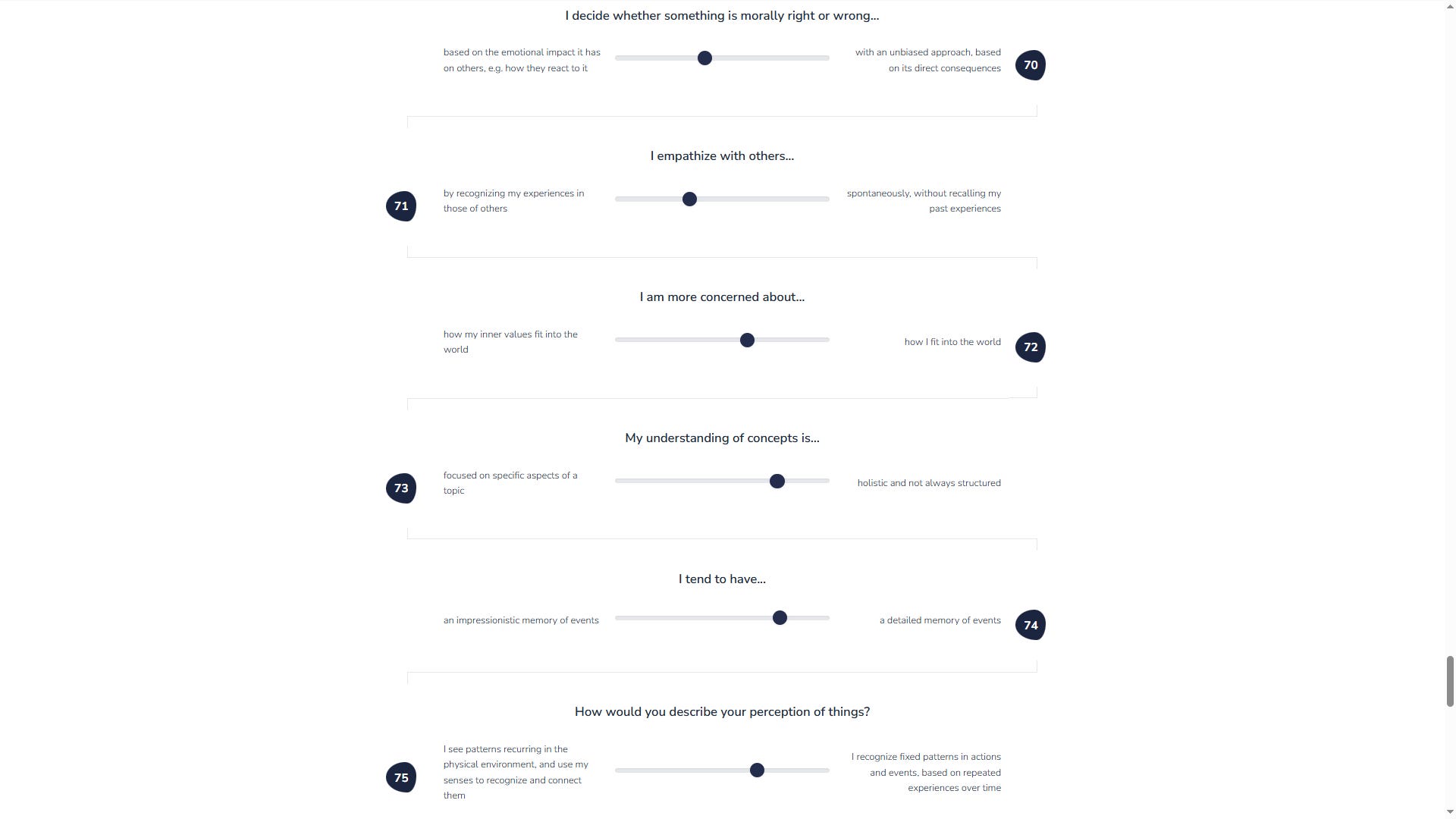
And now, the final set. Oh god, we’re about to get to the ending here! For this final run, I’ll be looking at how I relate to people, whether it’s by recognizing my experiences in theirs or acting spontaneously (Question 71). I’ll have to weigh my focus: am I more concerned with how my inner values fit into the world or how I physically fit in (Question 72)? My understanding of concepts is on the table—is it specific and focused or holistic and unstructured (Question 73)? I’ll also define my memory, choosing between an impressionistic vibe or a detailed record (Question 74), and describe my perception—do I see patterns in the environment or patterns in actions over time (Question 75)?
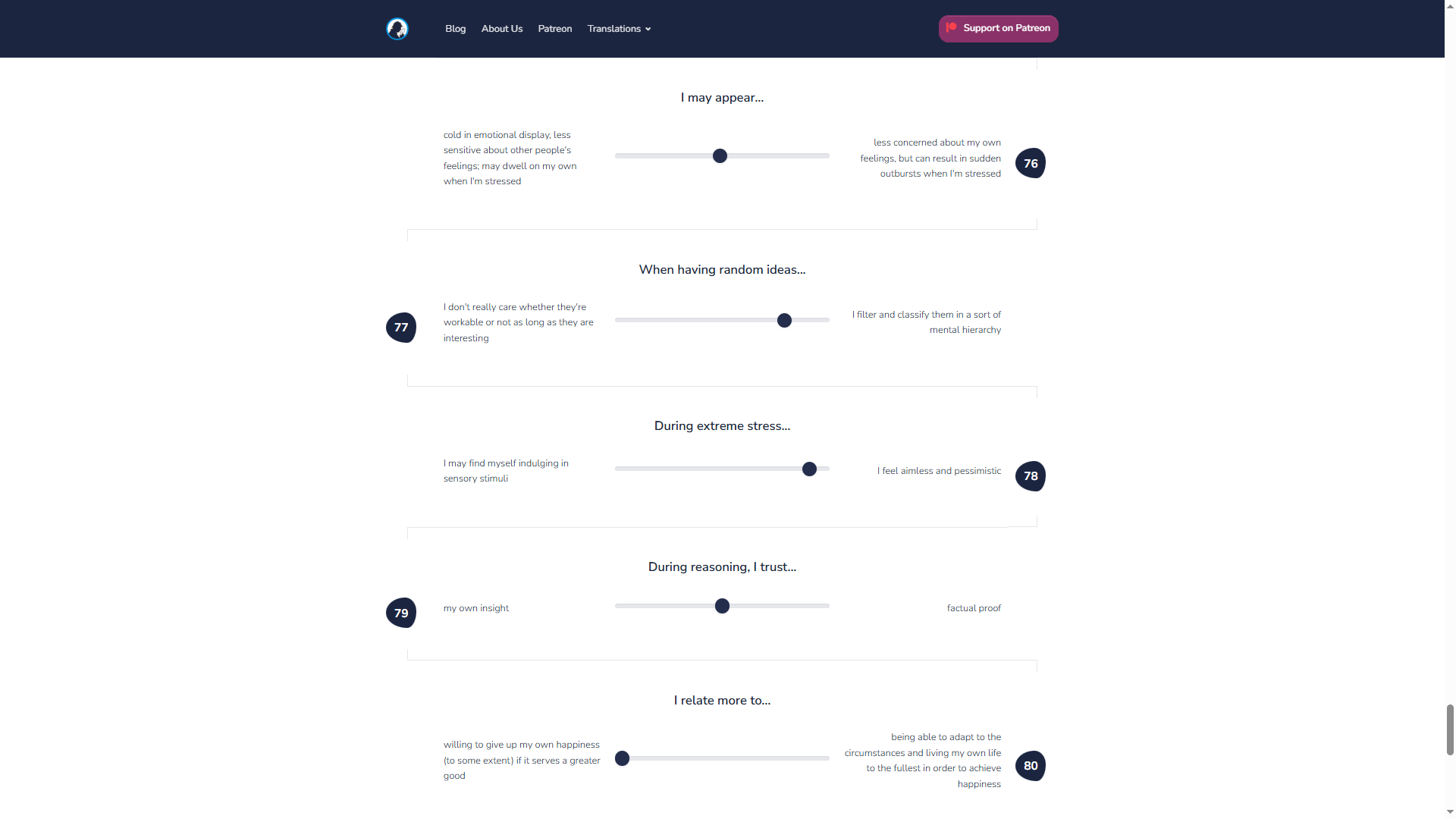
The set gets raw toward the end, asking how I appear when stressed (Question 76) and how I handle random ideas. Do I just enjoy them or do I filter and classify them (Question 77)? I’ll examine my behavior during extreme stress (Question 78) and whether I trust insight or factual proof when reasoning (Question 79). Finally, I’ll decide what I relate to more: the willingness to sacrifice personal happiness for a greater good or the drive to adapt and live life to the fullest (Question 80).
Closing out this journey felt like watching the final scenes of Endgame. When I empathize with others, I reach back into my own library of lived experiences to find a common thread (Question 71). I’m driven by a desire to see how I fit into the world (Question 72), balancing my inner values with my actual role in the community. My understanding of concepts is holistic, seeing the whole “wall of sound” rather than just the individual parts (Question 73), and my memory reflects this by being detailed and organized (Question 74).
I perceive the world through fixed patterns in actions and events (Question 75), which helps me navigate the music industry and my technical projects. When stress hits, I tend to withdraw emotionally (Question 76), but I’ve learned that I’m a Lead who steps up to fix what’s broken even when I’m scared. My random ideas are quickly classified into a hierarchy (Question 77), though under extreme pressure, I can fall into a pessimistic and aimless void (Question 78). In my reasoning, I strike a perfect balance between personal insight and factual proof (Question 79). Ultimately, I chose the “Hero Move”: I am willing to give up my own happiness if it serves a greater good (Question 80).
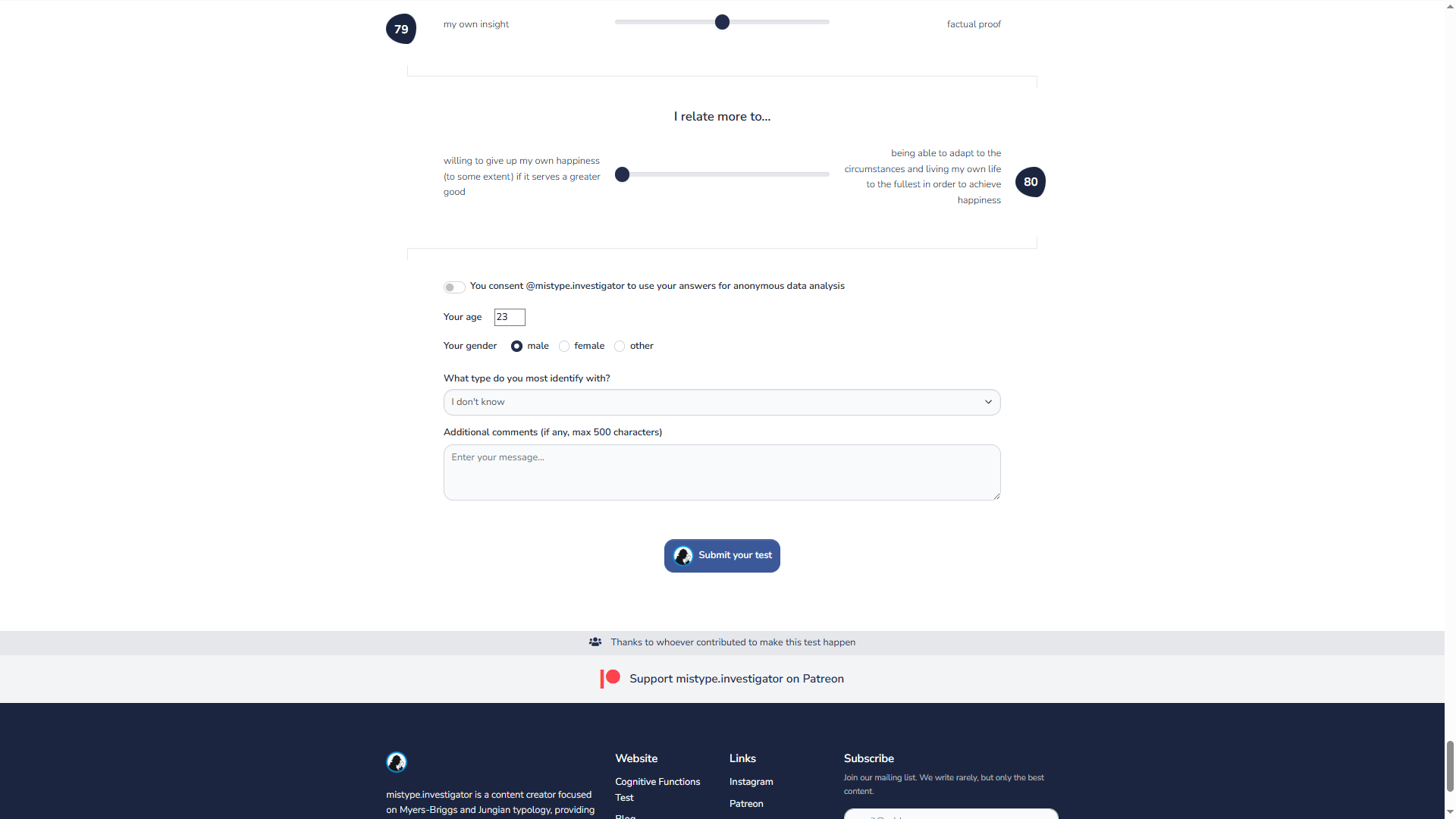
Now, it’s done. Truly done. Every question has been answered, every internal file has been opened. All that’s left is to fill in these final details and hit that submit button.
I find myself staring at the cursor, wondering what the results will say. In a world of ‘1 vs 100,’ where I’ve had to fight for my vision and survive the drama, who am I really? Am I the ‘Villain’—the one who had to become cold and logical to protect the label and stay standing? Or am I the ‘Kindness’, the one willing to sacrifice his own happiness to keep the atmosphere peaceful and the music alive? There’s only one way to find out…
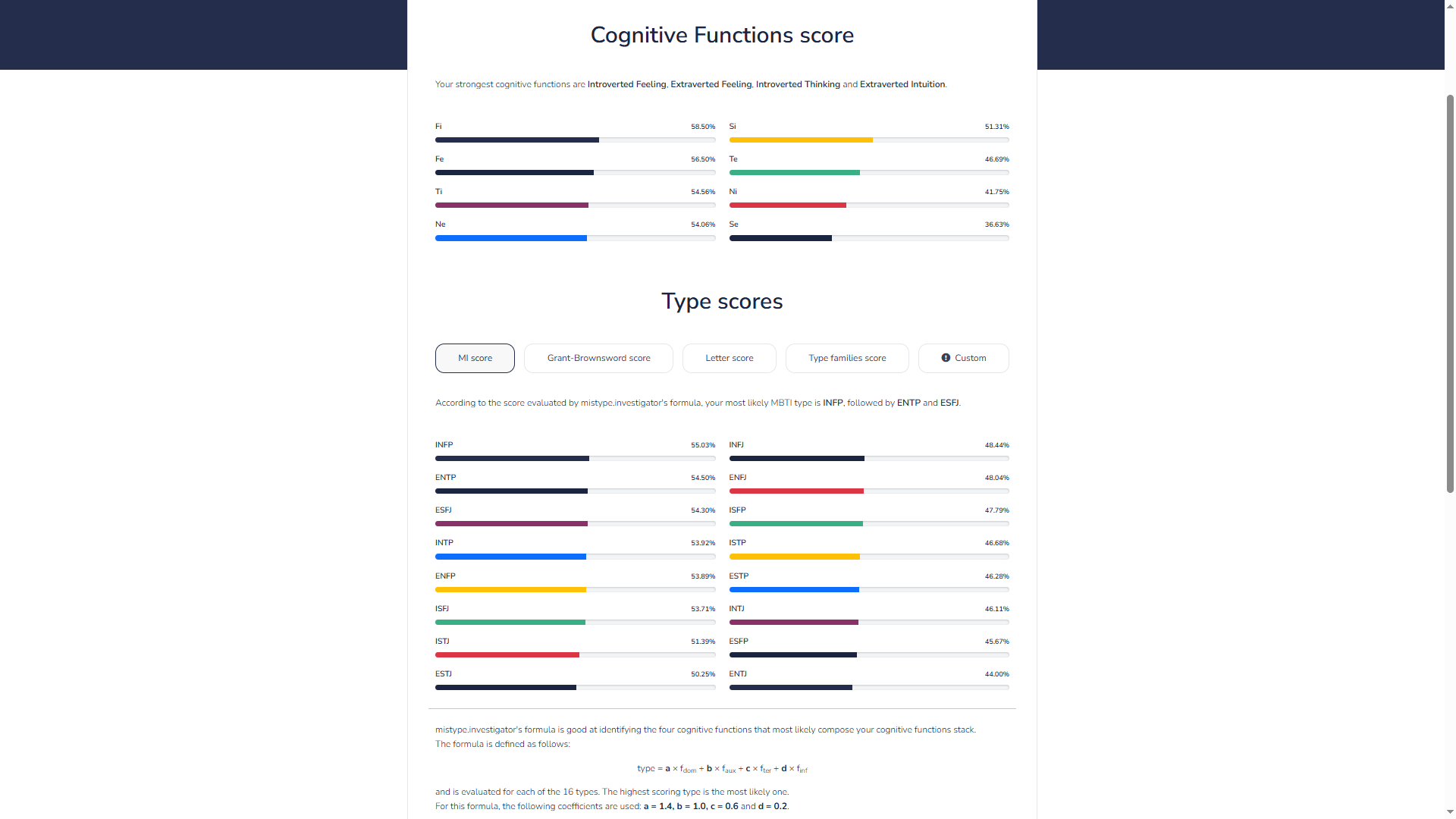
Looking at these results, things get a bit blurry. The numbers are almost identical, standing neck-and-neck in a three-way tie. But in the world of MBTI, even a tiny 1% difference dictates the ‘winner.’ According to the formula, I’ve moved away from the ‘Protagonist’ (ENFJ) label of my past. Now, I’m officially The Mediator—or the Idealist.
“INFP: 55.03% | ENTP: 54.50% | ESFJ: 54.30%”
It’s a razor-thin margin. I still feel a bit skeptical, but that’s okay. As Mistype Investigator admits, a perfect test doesn’t exist; they should always be taken with a grain of salt. I’m looking at this as a reference point, not a cage.
At the end of the day, I’m still the same person, an ambivert who walks the line between logic and heart. I can flip the switch to be an extroverted leader when Beaconwave needs me, but I remain deeply sensitive. I’m still the boy who is easy to cry, who still loses his heart to a cute anime girl, and who continues to push the boundaries of EDM as Hypeventure. Whether I’m a ‘Mediator’ or a ‘Protagonist’ doesn’t change my mission: combining the obscure, beautiful energy of Japanese aesthetics with the power of a Garrix-style anthem.
Making this episode has taken its toll. It’s been a wrecking, exhausting, yet revealing process. Even now, with the results on the screen, I can’t fully confirm if I’m the Protagonist, the Healer, or someone else entirely. The lines between who I am and who the test says I am, are still blurred, so I’ll leave the final verdict to the world. I’ll let my actions, my music, and my interactions with all of you decide who I really am as we move forward. This has been Episode 24 of Hypeventure’s Journal Diary. Hypeventure, signing out.
80 questions and a three-way tie. That's not your problem; that's a measurement problem.
BaZi Astrology (Omnigram) skips the questions entirely. Birth date only. No sliders, no self-reflection required. The profile arrives before you've had a chance to second-guess yourself.
Might be worth running just to see if it cuts through the blur.